In the last few months, I have sat down for over 100s of conversations with leaders across the financial services sector. These were top-level leadership teams at investment banks, private equity, and consulting firms. One anxiety dominates every discussion. It is the realization that while the leadership debates high-level AI policy, their teams are liquidating the firm's intellectual property in real time.
We are seeing a phenomenon called Shadow AI. As tools like ChatGPT and Claude became essential for productivity, a dangerous habit took root in the front office. Deal teams began trading decades of hard-earned wisdom for minutes of convenience.
The Rise of Shadow AI in the Front Office
Most leaders worry about external hackers or systemic breaches. The reality is that the most significant threat to a financial firm today is the prompt bar.
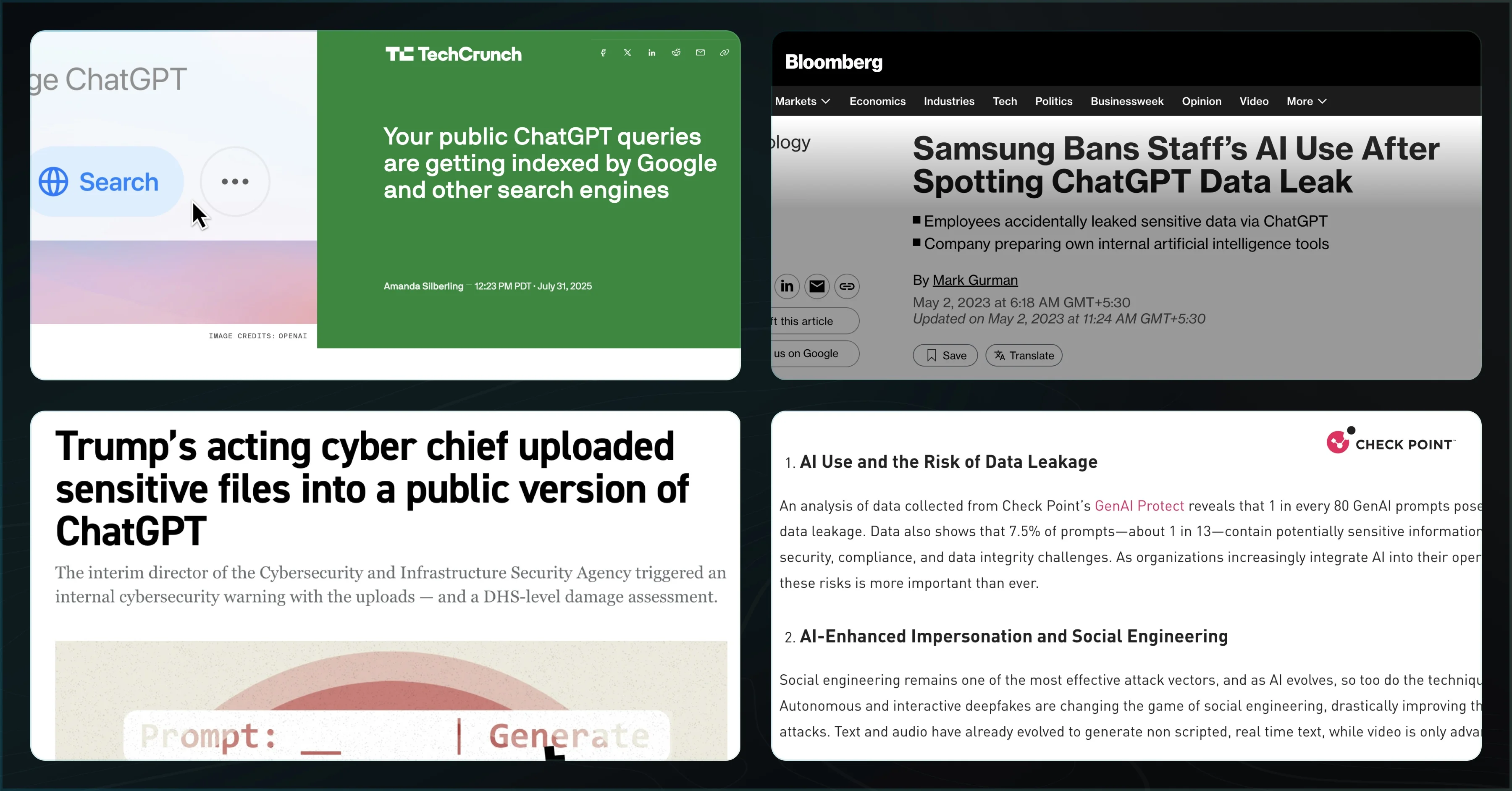
When a junior associate uploads a sensitive data room to a personal ChatGPT account to summarize it, they are not just being efficient. They are performing an unintentional IP liquidation. According to the Check Point 2026 Cyber Security Report, roughly 1 in every 41 prompts in enterprise environments is now classified as high-risk.
The behavior is reckless, but the incentive is clear. Human beings will always choose the path of least resistance. If a personal account offers a faster way to finish a due diligence report at 2:00 AM, the employee will use it. In that moment, your firm's alpha becomes part of a public training set.
Why Personal Accounts are the New Insider Threat
The use of personal accounts for work tasks is a massive blind spot. Employees often assume that "deleting" a chat removes the data. It does not. Public models are designed to learn from every interaction unless they are strictly governed by enterprise-grade service level agreements.
We have seen this play out with major precedents like the 2023 Samsung leak, where proprietary semiconductor code was fed into ChatGPT and the 2025 ChatGPT urls getting indexed on Google.
In January 2026, the irony reached its peak: Madhu Gottumukkala, acting director of the US Cybersecurity and Infrastructure Security Agency, the very organization tasked with defending federal networks from sophisticated nation-state threats, uploaded sensitive documents marked "For Official Use Only" to ChatGPT's public platform.
CISA's own automated security systems flagged the uploads, triggering multiple alerts and a Department of Homeland Security damage assessment. The head of American cybersecurity had just fed sensitive government contracting information into a system accessible to 800 million users worldwide.
The problem has scaled beyond isolated incidents. Deal teams are now uploading entire CIMs and due diligence files into unmanaged environments. This creates a permanent record of your most sensitive future plays in a third-party database.
Beyond Data: The Harvesting of Knowledge Bases
The conversation about AI usually focuses on data privacy, but for financial leaders, the stakes are higher. The true value of a firm lies in its proprietary frameworks, its specific valuation methodologies, and its internal knowledge base.
In financial services specifically, the exposure goes far deeper than confidential documents. Professionals are uploading deals they're actively working on, companies they're conducting due diligence on, and summarizing sensitive data rooms through ChatGPT prompts. The real intellectual property leak beyond this is the decades of accumulated wisdom being fed into public models: proprietary investment frameworks that took 20 years to develop, specific valuation methodologies tailored to niche sectors, internal scoring models for founder assessment, custom due diligence checklists refined through hundreds of deals, and sector-specific risk matrices that represent institutional knowledge.
When your team passes these frameworks into a public LLM via custom GPTs or skills, they are effectively training your future competitor’s co-pilot. Jason Calacanis, an angel investor, serial entrepreneur, and prominent technology podcaster, has highlighted this specific risk on the All-In Podcast, noting that the trade-off between speed and sovereignty is often a losing game for incumbents. You are giving away the "Secret Sauce" that took twenty years to build.
Years of firm-building and institutional wisdom can be absorbed by a model in minutes. Once your methodology is generalized by a public model, your competitive moat begins to evaporate.
The Shift Toward Sovereign AI and Air-Gapped Alpha
At Wokelo, we built our platform to address this exact crisis. We provide a single tenant domain-tuned environment for dealmakers that operates like a secure vault.
- Complete Data Isolation: Your prompts and uploads never leave your instance.
- Zero Training: Our models do not learn from your proprietary logic or deal data, all LLM processing happens on your privately hosted cloud
- Anonymization and Encryption: Our proprietary tech breaks every data and prompt into anonymized chunks which are encrypted in transit and rest
- Institutional Rigor: Every output includes line-level citations back to your secure documents, eliminating the "hallucination" risks that plague public chatbots.
- Securely Codifying Your Institutional Frameworks: Beyond simple chat, Wokelo allows you to securely digitize and automate your firm’s unique workflows. Whether it’s a specific due diligence checklist or a proprietary sector-scoring rubric, you can codify these frameworks into Agentic Workflows that automate research without the risk of IP liquidation.
Modern Governance is a Technical Requirement
Governance in 2026 is no longer about writing a policy for a handbook. It is a technical requirement for your software stack. A policy cannot stop a reckless upload, but a secure environment can.
The problem isn't that employees are malicious, it's that they're efficient. When analysts face a 200-page CIM that needs summarizing by EOD, they'll use AI tools, you need to give them something that is approved, battle-tested, secure for enterprise use and tuned to your specific workflows.
This is why the shift from public convenience to sovereign AI is an existential business requirement. The firms that treat AI governance as a compliance checkbox will watch their proprietary methodologies become commoditized. The firms that treat it as infrastructure will preserve their competitive moat.
Leaders must move their teams from public convenience to professional-grade security. The era of experimenting with public chatbots for high-stakes financial work is over. The cost of convenience is your intellectual property. Once your wisdom is in the public cloud, it belongs to everyone.