The agentic AI market in financial services stands at $5.51 billion in 2025 and projects to reach $33.26 billion by 2030. That's a 43.28% compound annual growth rate signaling fundamental change in how financial institutions operate.
The momentum is real: 53% of financial services executives report their organizations already use AI agents in production. Of those, 40% have deployed more than ten distinct agents across their operations.
This Isn't Just Another Automation Wave
AI agents represent something qualitatively different from the robotic process automation or decision-tree systems that defined the last decade.
Traditional AI required explicit programming for every scenario. AI agents in financial services can perceive their environment, interpret complex data patterns, make contextual decisions, and execute actions autonomously within predefined parameters.
The question facing dealmakers, investment professionals, and financial strategists is no longer whether to adopt agentic AI. It's how to deploy it without compromising the precision and reliability that defines institutional-grade financial services.
What Makes AI Agents Different From Generative AI
The distinction between generative AI and agentic AI matters more than most marketing materials suggest.
Generative AI creates content based on prompts. It's fundamentally reactive. You ask, it generates. The relationship is transactional and stateless.
AI agents operate differently. They combine large language models with reasoning frameworks, memory systems, and tool-calling capabilities to pursue goals across multiple steps.
Real-World Example
An AI agent doesn't just answer questions about a portfolio company's financial health. It:
- Monitors the company continuously
- Cross-references earnings data against market signals
- Identifies anomalies that deviate from historical patterns
- Flags risks before they materialize
- Routes urgent findings to the appropriate analyst with supporting documentation
The Architecture Behind Agents
The system includes perception layers that continuously ingest structured and unstructured data, reasoning engines that evaluate information against objectives, decision frameworks that determine which actions to take, and execution layers that interact with other systems.
Guardrails built into the system ensure agents operate within compliance parameters, approval thresholds, and security protocols. Financial institutions cannot afford black-box decision-making.
Every action an AI agent takes must be auditable, traceable, and explainable. This requirement shapes how responsible firms architect their agent systems.
Why Financial Services Demands More Than Generic AI Solutions
Precision in financial services isn't aspirational. It's foundational.
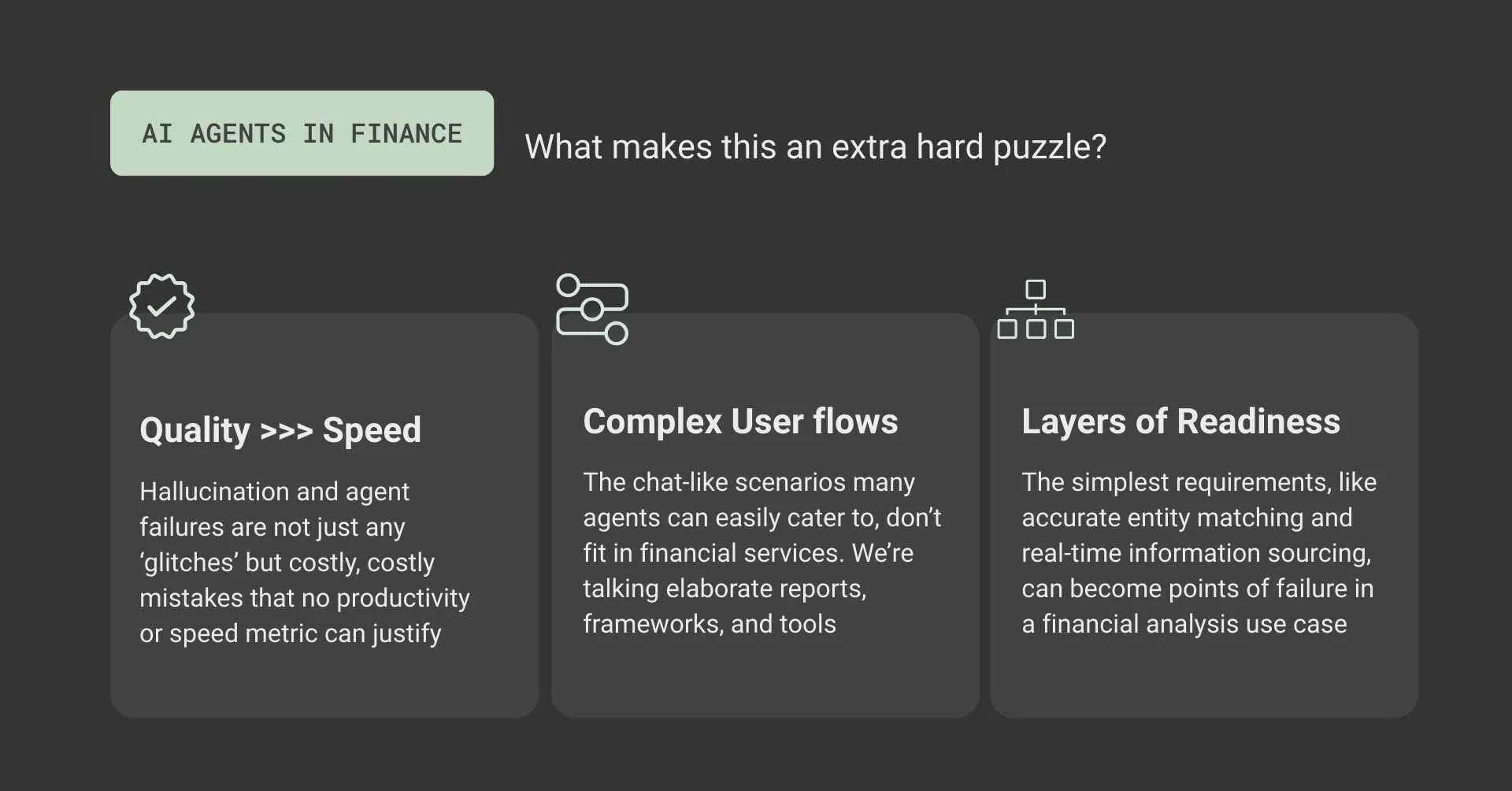
A single incorrect data point in a credit assessment can trigger cascading failures across risk models. A hallucinated metric in an investment memo can misallocate millions in capital. A fabricated compliance citation can expose an institution to regulatory penalties.
The Hallucination Problem
Research published in 2024 found that large language models hallucinate in up to 41% of finance-related queries. Domain-specific studies show hallucination rates between 3% and 27% even in state-of-the-art models.
When Stanford researchers tested general-purpose chatbots on legal and financial questions, hallucination rates ranged from 58% to 88%.
These aren't acceptable error rates for institutions managing billions in assets or executing time-sensitive transactions where a 0.5% valuation discrepancy translates to millions of dollars.
The Private Markets Data Challenge
The challenge intensifies with private market data, where information is fragmented, proprietary, and inconsistent.
Public equities trade on regulated exchanges with standardized reporting. Private companies operate in information-sparse environments where entity matching becomes non-trivial. Two companies with identical names operating in different sectors require precise disambiguation.
A single misattribution in a target screening process wastes weeks of diligence effort on the wrong entity.
Why Domain Expertise Matters
Generic AI tools trained on internet-scale data lack the domain precision required for institutional finance. They don't understand:
- The nuances of private equity deal structures
- The specific language used in venture capital term sheets
- The regulatory requirements that vary across asset classes and jurisdictions
Building reliable AI agents for financial services requires domain-specific training, verified data pipelines, and multi-layered validation systems that go far beyond consumer chatbot standards.
How Private Equity and Investment Banking Actually Use AI Agents
The use cases emerging in 2025 aren't theoretical. Leading firms report measurable productivity gains and competitive advantages from targeted AI agent deployments.
1. Deal Sourcing at Scale
Traditional deal sourcing suffered from coverage gaps. According to benchmark data, private equity firms typically see just 16.5% of relevant deals in their target markets using conventional methods.
AI-powered sourcing platforms change this equation by continuously monitoring millions of data sources:
- News feeds and press releases
- Patent filings and regulatory documents
- Hiring trends on professional networks
- Social signals and industry discussions
The results speak for themselves. Some firms report AI systems can identify 195 relevant target companies in the time a junior analyst finds one manually.
The productivity gain isn't just speed. It's coverage. Firms can evaluate broader opportunity sets while applying more rigorous filters to prioritize high-conviction targets.
2. Due Diligence Compression Without Quality Sacrifice
Due diligence traditionally consumed 90% of analyst time on manual data processing and only 10% on strategic analysis. AI agents flip this ratio.
What AI agents handle automatically:
- Ingest thousands of pages from virtual data rooms
- Extract key financial metrics and contract clauses
- Identify customer concentration issues
- Flag anomalies that would take human teams weeks to discover
Private equity firms using AI-assisted due diligence report up to 70% reduction in manual diligence hours. One firm documented cutting financial modeling time by 90% through intelligent automation.
Pattern Matching Across Historical Deals
The systems excel at pattern matching. An AI agent trained on a firm's deal history can flag when a target company's cap table structure matches patterns that previously led to failed transactions.
This institutional memory becomes queryable and actionable rather than trapped in email archives and partner recollections.
Critically, AI-driven diligence enables more comprehensive analysis within the same timeframe. Where traditional processes forced trade-offs between depth and speed, autonomous agents can simultaneously analyze competitive positioning, customer sentiment, and ESG compliance across multiple regulatory frameworks.
3. Portfolio Monitoring That Scales
Limited partners expect crisp execution on value creation plans. With more than 4,000 portfolio companies in the United States alone aged over five years waiting to exit, and 84% of fund managers reporting longer holding periods, portfolio management has become as important as deal origination.
What AI agents monitor continuously:
- EBITDA performance against targets
- Customer acquisition costs against benchmarks
- Competitive moves through news and social signals
- Operational inefficiencies from financial reporting inconsistencies
The systems standardize disparate reporting formats automatically. Portfolio companies submit financial data in wildly inconsistent structures. AI agents normalize this information, enabling fund managers to analyze trends across the entire portfolio.
This eliminates significant administrative burden and reduces the lag between operational reality and management insight.
4. Investment Committee Memo Generation
Investment committees require comprehensive documentation that synthesizes market analysis, competitive intelligence, financial modeling, risk assessment, and strategic rationale.
AI agents can draft initial investment memos by pulling together relevant market research, financial data, comparable transaction analysis, and due diligence findings into structured documents. The system ensures consistency in how information is presented.
Senior professionals focus on refining strategic arguments rather than compiling source material.
Platforms like Wokelo have developed specialized capabilities for generating institutional-grade investment research that meets the standards top-tier firms expect. The difference lies in understanding the specific analytical frameworks different types of investors employ and the evidence standards they require.
The Reliability Problem and How Leading Firms Solve It
Acknowledging the hallucination challenge is step one. Building systems that architect around it is where sophisticated firms differentiate themselves.
Domain-Specific Training Over General Models
General-purpose language models trained on internet-scale data have too many knowledge gaps in specialized domains. When an AI lacks specific information, it fills gaps with statistically probable text regardless of accuracy.
That's acceptable for consumer chat. It's unacceptable for financial decision-making.
Leading implementations train models specifically on:
- Historical earnings transcripts
- Regulatory filings and compliance documents
- Industry research and market intelligence
- Internal deal memos and investment theses
Domain-specific training reduces hallucinations by giving the model actual expertise rather than statistical word prediction.
Retrieval-Augmented Generation for Factual Grounding
Rather than relying solely on model memory, retrieval-augmented generation (RAG) systems fetch relevant information from verified databases in real-time before generating responses.
When an agent needs to answer a question about a company's revenue growth, it retrieves the actual financial data from a trusted source rather than predicting what the number might be.
This architecture dramatically reduces hallucination rates. The model's role shifts from inventing facts to synthesizing verified information from authoritative sources.
JPMorgan Chase's deployment of AI agents for fraud detection achieved a 95% reduction in false positive alerts by grounding decisions in real transaction data rather than letting models guess.
Multi-Model Validation and Cross-Checking
No single model is perfect. Sophisticated deployments query multiple independent AI systems with identical prompts and compare outputs.
Discrepancies between models flag potential hallucinations for human review. Agreement across diverse models increases confidence in output accuracy.
Human-in-the-Loop for Critical Decisions
Automation doesn't mean removing human judgment. It means elevating human judgment to higher-value decisions.
The agent handles:
- Data aggregation and pattern recognition
- Preliminary analysis and draft generation
- Routine monitoring and anomaly detection
Humans provide:
- Strategic context and nuanced judgment
- Validation of outputs against experience
- Final accountability for critical decisions
This partnership model leverages AI's computational scale while preserving human expertise where it matters most.
Production Challenges Beyond Model Performance
Getting AI agents to work in demos is easy. Running them reliably at scale across an enterprise is exponentially harder.
Infrastructure and Cost Management
A single sophisticated research report might require a thousand individual model calls. Multiply that across dozens of concurrent users and you're orchestrating hundreds of thousands of API requests daily.
Early implementations sometimes generate six-figure monthly bills as agents consume compute resources inefficiently. Optimizing for cost while maintaining quality requires careful engineering.
Managing User Expectations
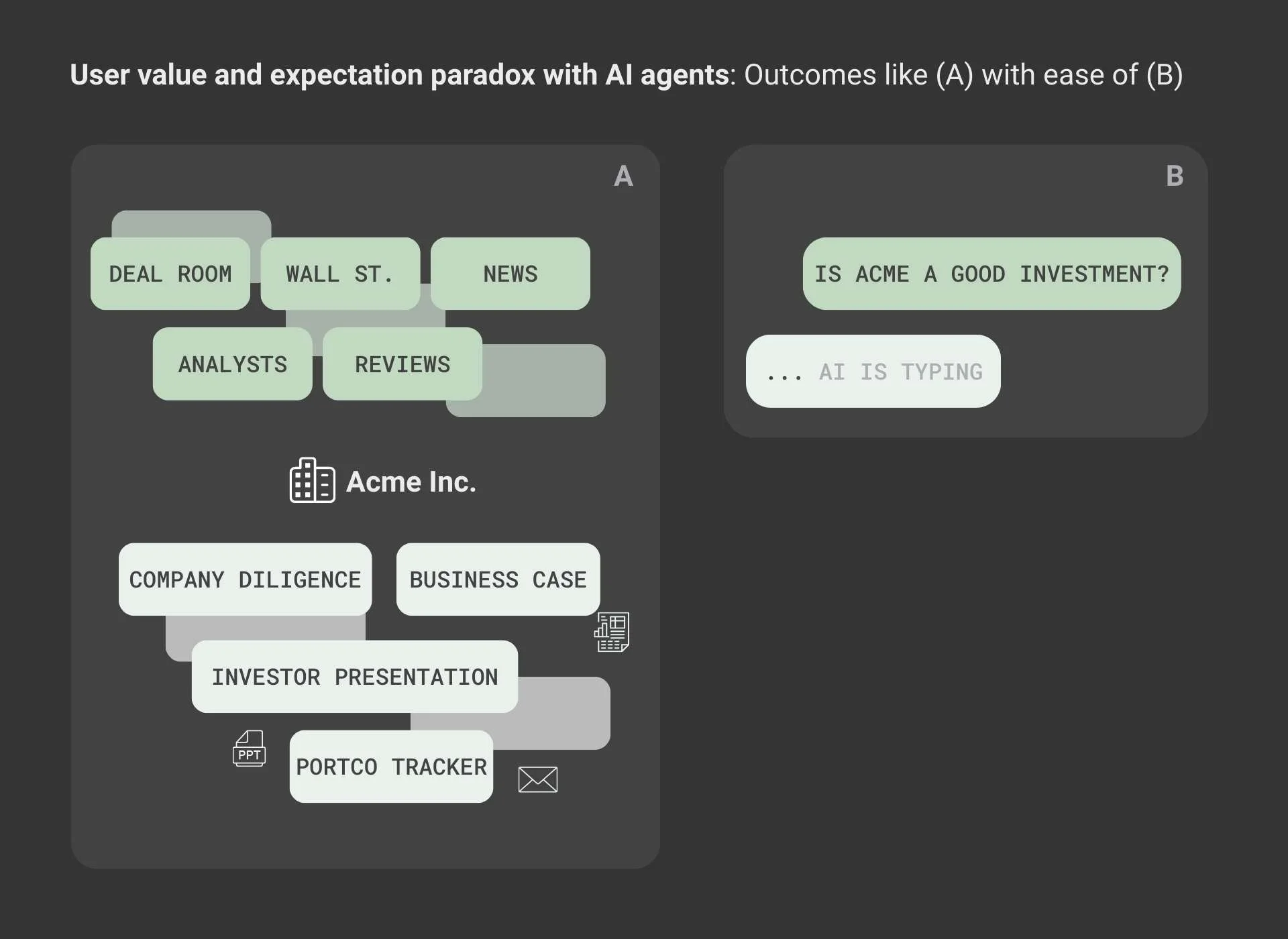
Users accustomed to chatbot-style instant responses struggle when comprehensive financial analysis takes minutes or hours. The most robust analyses genuinely require time.
Successful implementations:
- Set clear expectations about processing time
- Provide progress indicators showing system activity
- Enable users to continue other work while agents process
- Notify users when results are ready
Financial professionals understand that quality research takes time. They accept delays when deliverables provide genuine value.
Integration With Legacy Systems
Financial institutions operate complex technology stacks with decades of accumulated systems. Building secure, reliable integrations that maintain data governance and preserve audit trails requires significant engineering effort.
Many AI initiatives stall not because the models fail but because the integration work proves more complex than anticipated.
Companies are instead experimenting with embedded experiences, such as APIs that link directly to a firm’s internal tools and dashboards, or with background processes that email a completed deliverable once finished. Some solutions provide a collaborative interface that shows progress indicators (“collecting data,” “validating references,” “generating conclusions”) to manage user expectations about the time required for complex tasks.
Strategic Implementation for Competitive Advantage
The gap between experimenting with AI and achieving production value comes down to execution discipline.
Start With High-ROI, Manageable Scope
Firms trying to transform every workflow simultaneously usually fail.
Successful implementations identify specific, high-value use cases where AI agents solve clear pain points. Due diligence automation, portfolio monitoring, or competitive intelligence gathering make excellent starting points.
Run initial deployments as pilot programs with limited scope. Measure results rigorously. Iterate based on feedback. Scale what works.
Build Internal AI Literacy
Technology departments cannot drive AI adoption alone. Investment professionals need to understand what AI agents can and cannot do.
Training programs should focus on:
- Effective prompt engineering
- Output validation techniques
- Understanding confidence scores and uncertainty indicators
- Recognizing when to escalate to human experts
Organizations that treat AI literacy as a firm-wide capability rather than a technical team responsibility achieve better adoption and results.
Establish Clear Governance and Accountability
Who owns AI agent outputs? Who's accountable when an agent makes a mistake? What approval processes apply to agent-generated analysis?
These questions need clear answers before production deployment.
Governance frameworks should define:
- Which tasks agents can handle autonomously
- Which require human approval before execution
- Which remain human-only
- Quality standards for training data
- Incident response procedures when agents fail
Documentation is critical. Every agent decision should be logged with source attribution, reasoning transparency, confidence levels, and human review records.
The Competitive Dynamics Reshaping Financial Services
The market for AI in financial services was valued at $35.57 billion in 2023 and projects to reach $150.26 billion by 2030.
According to EY research, 50% of private equity respondents believe generative AI and agentic AI will have the most transformative impact on their industry over the next three years.
First-Mover Advantages That Compound
Firms moving early accumulate advantages that compound over time:
- Build proprietary datasets that improve model performance
- Develop organizational capabilities competitors cannot easily replicate
- Attract talent seeking to work with cutting-edge technology
- Deliver faster, deeper insights to limited partners
Speed With Quality
But speed without quality creates risk. Deloitte's 2025 State of Generative AI report found that 35% of organizations hesitate to adopt AI because it can produce errors.
That hesitation is rational when errors carry institutional consequences.
The answer isn't avoiding AI. It's implementing it responsibly with realistic expectations, appropriate validation, and clear accountability structures.
Platforms purpose-built for financial services, like Wokelo, address these requirements from the ground up by combining domain expertise with technical sophistication.
What Actually Works in 2026
Real-world deployments reveal clear patterns in what succeeds versus what fails.
Success Factors
Clear problem definition with measurable outcomes. Vague goals like "use AI to be more efficient" fail. Specific targets like "reduce time spent on market research by 40%" succeed.
Investment in data infrastructure before model deployment. The quality of AI outputs depends directly on the quality of input data. Organizations that clean their data and establish clear governance see better results.
Realistic expectations about AI capabilities. AI agents excel at pattern recognition, data synthesis, and repetitive analytical tasks. They struggle with nuanced judgment calls and creative strategic thinking.
Strong partnerships between business users and technical teams. The best implementations emerge when investment professionals articulate their needs clearly and technology teams translate those into effective systems.
Common Failure Patterns
Deploying AI without validation frameworks then discovering outputs aren't trustworthy when it matters.
Building custom solutions from scratch instead of leveraging purpose-built platforms, wasting months on infrastructure rather than value creation.
Expecting AI to replace human expertise rather than augment it, leading to either over-reliance or complete dismissal.
Neglecting change management and user training, leaving agents underutilized despite significant investment.
Looking Forward: The Path to Institutional-Grade Autonomous Intelligence
The vision of AI agents that can generate complete industry analyses, build sophisticated financial models, and produce investment committee-ready presentations in minutes isn't science fiction.
It's engineering work that requires combining advanced language models with domain-specific training, verified data pipelines, multi-layered validation, and thoughtful user experience design.
Current Technology Already Enables Transformative Use Cases
The bottleneck isn't model capabilities. It's implementation discipline.
Organizations that approach AI agents as strategic infrastructure rather than experimental technology will define the next decade of financial services.
The Competitive Question
For private equity firms, venture capital funds, investment banks, and strategic advisory firms: will you lead the adoption of autonomous intelligence or follow once competitors have established advantages?
The firms answering correctly are:
- Building capabilities now through disciplined pilots
- Measuring results rigorously
- Scaling proven approaches
- Partnering with platforms that understand institutional finance
- Investing in data quality, governance, and team training
The Market Reality
The agentic AI market will grow from $5.51 billion to $33.26 billion by 2030 not because of hype but because the technology delivers measurable value when implemented correctly.
The 77% of financial services executives reporting positive ROI within the first year aren't chasing trends. They're capturing real productivity gains, faster decision cycles, and competitive differentiation.
The transformation is already underway. The question is whether your organization will shape it or react to it.
About Wokelo
Wokelo provides institutional-grade AI agents purpose-built for private equity, venture capital, and investment banking professionals. Our platform combines domain-specific language models, verified data pipelines, and multi-layered validation to deliver research, due diligence, and analytical capabilities that meet the precision standards top-tier financial institutions require. Book your demo.